Tunnel Rush Obstacles: Every Shape in the Tunnel and How to Get Through It
Published · 3 min read
Every Tunnel Rush run is the same few obstacle shapes arriving in a different order, at a higher speed, through a tunnel that keeps repainting itself. Once you can name the shapes, you stop reacting to colour and start reacting to geometry, and your distance jumps. Here is what comes at you and how to handle each one.
How the tunnel works
The tunnel is a tube with flat faces, like the inside of a pencil. You are always facing forward and always falling in the same direction; pressing Left or Right rotates the whole tube around you, so the face you are "standing" on changes. That is the only movement you have. You cannot slow down, stop or jump. The top bar tells you two things: distance in metres on the left, which is your score, and speed in metres per second on the right. Speed starts in the mid-60s and keeps rising, so an obstacle you dodged easily at 100 m is the same obstacle arriving much sooner at 400 m.
The panel with one open face
The most common obstacle is a solid panel that covers the tube except for one face, or a couple of neighbouring faces. It is the easiest to read because the gap is a single clear shape. The mistake is over-rotating: holding the key spins you past the gap. Tap once or twice, count the faces, and be settled in the opening a moment before it reaches you.
Block clusters
Groups of cubes sit on some faces and leave others clear. They are harder because there is no single gap outlined for you; you have to see which faces are empty. Look for the widest run of empty faces and aim for its middle. If two clusters come back to back, choose a face that is clear for both, even if it means rotating further for the first one.
Angled bars and sweeping pieces
Some obstacles cross the tunnel at an angle or sit off-centre, so the open part is a wedge rather than a neat face. These are the ones that catch people who aim at the edge of a gap. Aim for the widest part of the wedge, not the first open pixel you see.
Paint changes
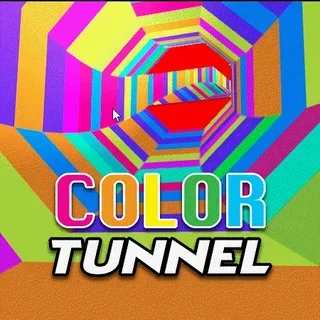
The tunnel does not keep one colour scheme. Early on it is striped in bright bands of yellow, orange, pink and green; deeper in, whole sections switch to new palettes, and one of them is a hard black-and-white chequer with red blocks. Nothing about the obstacles changes, but for a second your eyes have to relearn where the edges are. Many runs end exactly there. When you see the colours shift, make your next few moves smaller and slower.
Sequences
At higher speeds the shapes arrive in chains, and getting through the first one in the wrong spot leaves you too far from the next gap. The fix is to look past the nearest obstacle. If the second gap is to the left, go through the first gap on its left side. Planning two obstacles ahead is the single biggest jump in skill Tunnel Rush has.
After a crash
The screen flashes red and the result card shows the distance you reached, with NEW RECORD on top if you beat your best. Retry starts again at 0 m; the house button goes back to the title card. Take one breath before pressing Retry. Most people lose their next run in the first hundred metres because they come back tense.
More from the blog
- Tunnel Rush on a Chromebook: Keys Not Working, Lag and Lost Records
Why the arrow keys scroll the page, how to stop the stutter at high speed, and where your best distance is actually saved.
- Tunnel Rush: 10 Questions Players Ask, Answered
What Tunnel Rush is, whether it is free, which keys you use, who made it, how pausing works and why the tunnel gets so hard — answered in plain English.